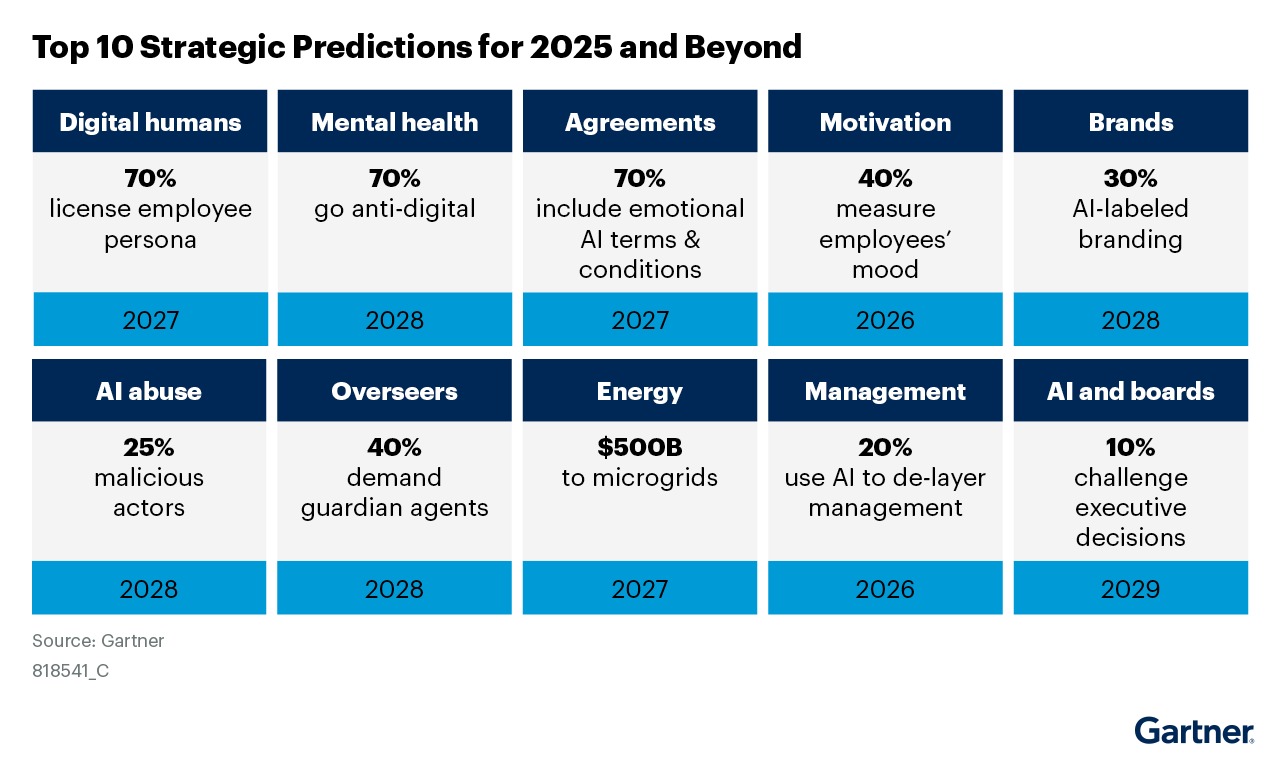
Artificial Intelligence (AI) is reshaping industries at an unprecedented pace, and Gartner’s latest research highlights the transformative impact AI will have by 2025 and beyond. From privacy concerns to operational risks and management restructuring, the AI whirlwind is pulling organizations into a new era of innovation and challenges. Here’s a closer look at Gartner’s top strategic predictions and their implications for businesses worldwide.
Key Predictions and Insights
1. Privacy and Personas
By 2027, 70% of new employee contracts will include clauses for licensing AI representations of their personas. This shift raises critical questions about ownership and ethical use of digital avatars, which are becoming increasingly common in workplaces.
2. Operational Risks
AI’s growing autonomy introduces new vulnerabilities. By 2028, 25% of enterprise breaches will stem from AI agent abuse. Organizations must adopt robust security measures, including “guardian agents” to oversee AI activities.
3. Management Restructuring
AI is set to flatten organizational hierarchies. By 2026, 20% of companies will use AI to eliminate over half of middle-management roles, streamlining decision-making processes but also raising concerns about workforce morale and job security.
Emotional AI in Healthcare
By 2027, 70% of healthcare providers will include emotional-AI-related terms in contracts to mitigate risks. Emotional AI is revolutionizing patient care but also poses ethical and privacy challenges.
Digital Addiction and Social Isolation
By 2028, 70% of organizations will implement anti-digital policies to combat the effects of digital addiction and social isolation, which are predicted to affect one billion people globally.
AI-Driven Branding
By 2028, 30% of S&P companies will use generative AI (GenAI) labeling to reshape their branding, unlocking new revenue streams and enhancing customer experiences.
Energy and AI Demand
Fortune 500 companies will shift $500 billion to microgrids by 2027 to address energy demands driven by AI and mitigate risks of power outages.
AI in Executive Decision-Making
By 2029, 10% of global boards will use AI to challenge executive decisions, ensuring data-driven strategies and reducing human bias.
Strategic Recommendations
To navigate the AI whirlwind, Gartner advises organizations to:
Revise Contracts: Include clauses for AI persona usage to address legal and ethical concerns.
Enhance Security: Deploy AI “guardian agents” to monitor and mitigate risks.
Reskill Workforce: Prepare employees for AI-driven changes through training and upskilling.
Adopt Anti-Digital Policies: Promote work-life balance and mental health by limiting digital overuse.
Invest in Energy Solutions: Develop microgrids to ensure reliable power for AI operations.
Conclusion
AI is not just a technological advancement; it’s a combinatorial force reshaping every aspect of business and society. Organizations that embrace AI’s potential while addressing its risks will be better positioned to thrive in this new era. Gartner’s strategic predictions serve as a roadmap for navigating the challenges and opportunities of the AI whirlwind.
For more insights, visit [Gartner’s official website](https://www.gartner.com).